

The living room is the hardest room in the house to get right. Not because it's technically complicated, but because nobody can really agree on what it's for.
You arrange things in it, rearrange them, move the sofa twice and put it back where it started. At some point you step back and try to figure out whether it feels like a place you actually want to spend time in, or just a room where the furniture lives.
A Name with History
"Living room" is a newer term than most people realize. For a long time, the space we're talking about was called the parlour, and it functioned more like a stage set than an actual room. Formal furniture, china on display, upholstery that nobody sat on. The whole thing existed for company that rarely came, arranged around the impression it made rather than the people who lived there.
The shift happened in the early 1900s. Edward Bok, who edited the Ladies' Home Journal, spent years writing against the parlour. His case was pretty simple: this room should be for the people who live here. He pushed "living room" as both a name and an argument. It caught on faster than you might expect, probably because people recognized the problem even before they had words for it.

What a Living Room Is Supposed to Be
Most rooms in a house have a job. The kitchen handles meals. The bedroom handles sleep. The living room is the exception, and that's where it gets complicated. It's supposed to accommodate whatever you need it to on any given evening, which sounds flexible but actually puts more pressure on how it's designed.
A good one handles a lot of different moods. Someone reading alone in the corner. A couple watching something. Friends who've been at the dinner table for three hours and migrated to the couch. It doesn't force a choice between quiet and sociable, between focused and switched off. The room just holds all of that without making any of it feel wrong.
That's harder to pull off than it sounds, and it's why so many living rooms feel slightly off even when nothing is obviously wrong with them. The space is doing something, but you're not sure what. It's organized around a default rather than a decision.
"A good living room doesn't push you toward any particular version of the evening. It just makes room for whichever one shows up."
The Distraction Problem
At some point, most living rooms quietly reorganized themselves around a television. Then a bigger television. Then a mounting bracket and a soundbar, all the furniture aimed in one direction like pews facing an altar.
Watching things is fine. That's not the issue. The issue is the version of a living room where the screen has become so central that nothing else is really possible in the space. You sit down and you're already watching something, because the room doesn't suggest any other option. That's a different room from one where the TV happens to be there.
A useful question to ask about your own space: does it make room for an evening without a plan? A book, a conversation, the particular pleasure of just sitting somewhere comfortable without anything specific happening. If the answer is no, the room is doing more work than you asked it to, and probably not in a direction you chose.
What Comfort Actually Means
Everyone says they want a comfortable living room, and almost nobody means the same thing by it.
The physical side is the easier part: a sofa that actually supports your back, cushions with some structure, a rug that isn't cold underfoot in the morning. These things matter and they're worth spending real money on. A bad sofa affects how you feel in a room every single day in a way that the wrong throw pillow never will.
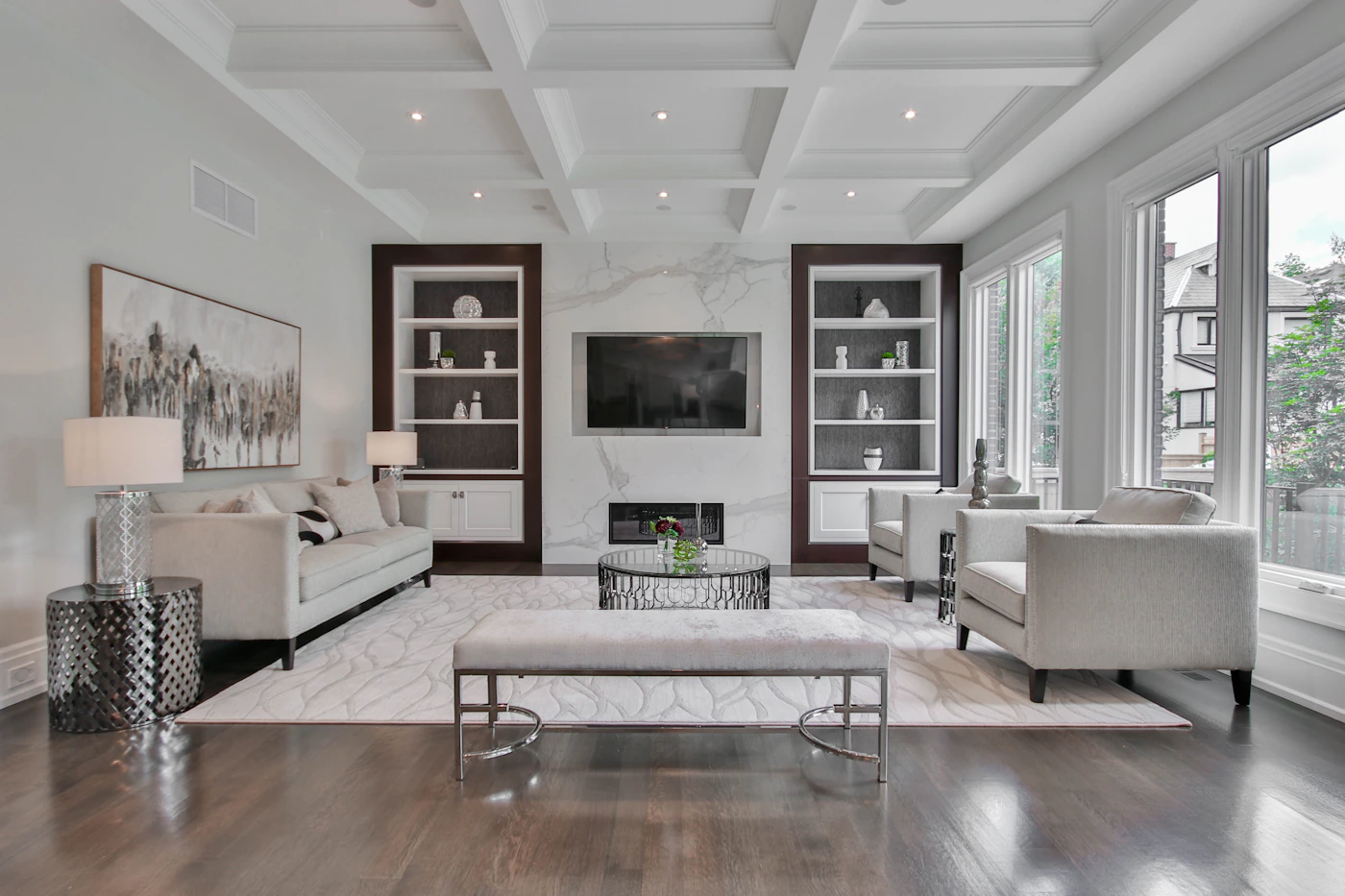
The other kind of comfort is harder to pin down. It has to do with how much the room is asking of you visually. Too many surfaces, too many things competing for attention, and the room starts to feel tiring even when you're supposed to be relaxing. A room doesn't have to be minimal to avoid this. It just can't be overwhelming.
The rooms that feel genuinely restful tend to have everything roughly in the right place, or at least in a place that isn't wrong. Nothing is asking to be looked at. You walk in and the room settles around you rather than the other way around.
A Few Things That Actually Matter
When a living room isn't working, the problem is usually one of a handful of things. In no particular order:
Figure out where the natural light comes from before you place anything. A sofa in a pool of afternoon sun is a different piece of furniture than the same sofa pushed against an interior wall. Most people decide where things go before they've spent enough time in the room to know where the light actually lands.
When something feels off, the instinct is to add something. Usually the problem runs the other direction. A room with fewer pieces you genuinely like will feel more settled than a full room of things you feel okay about. What you take out matters as much as what you put in.
Every living room orients around something, even if that something was never chosen. A fireplace, a view, a rug that anchors the seating, a piece of art on the right wall. It's worth making that a deliberate decision rather than noticing after the fact that everything ended up facing the TV by default.
Paint and styling sit on top of what's already there. The sofa you use every day, the chair you read in, the coffee table you reach across without thinking — those set the tone of the space in a way that surface-level changes don't touch. Spend accordingly.
A shelf with breathing room, a wall with nothing on it, a corner that's just a corner. These aren't things you ran out of time to fill. They're what make everything else in the room legible. A room that's too full can't be read, and a room you can't read is exhausting to be in.